Short answer: A drawdown limit is a floor your account can't fall below. A static floor never moves. A trailing floor rises as your account reaches new highs and doesn't come back down. Whether it trails on end-of-day balances or on intraday equity changes how much room you really have, so two accounts with the same advertised "$2,000 loss limit" can behave very differently.
Volatile days put this rule to the test. On November 13, 2026, Bitcoin fell below $70,000 for the first time since August, and CoinDesk reported $1.64 billion of crypto liquidations over 24 hours, most of them long positions. The Fed meets again on December 8–9. Prop firms are also changing their account rules: Topstep has been adding static-drawdown accounts through its Topstep Labs programme, and its help centre lists new $100K and $150K static versions in November.
If you trade, or plan to trade, an evaluation or funded account, you need to know exactly where your floor is and what makes it move. This guide explains the three common designs with one set of example numbers.
What "drawdown" means on a prop account
In a normal brokerage account, you can lose money for as long as you have money. On a prop firm evaluation or funded account, the firm sets a line you must not cross. Topstep calls it the Maximum Loss Limit. Other firms say drawdown floor, trailing threshold or something similar. Cross it and the account is closed, even if you could still have recovered.
The rule has two parts:
- Where the floor starts. Usually the starting balance minus the loss limit.
- Whether, and when, the floor moves. This is where designs differ.
Here is the example used below. All numbers are for illustration only.
- Starting balance: 50,000
- Loss limit: 2,000
- Starting floor: 48,000
Static drawdown: the floor never moves
With a static drawdown, the floor stays where it started for the life of the account. Make money and the floor stays at 48,000. Grow the account to 53,000 and the floor is still 48,000.
That means your room grows as you profit. At 53,000 you have 5,000 of room instead of the original 2,000. It's the easiest rule to reason about, because you know your line before the first trade and winning never pushes it closer.
Topstep's help centre gives its own comparison on a $50K static account: after earning $2,000 and giving back $1,000, a static floor leaves $3,000 of room the next day, where an end-of-day trailing floor leaves $2,000.
Trailing drawdown: the floor follows your highs
A trailing drawdown moves up as your balance reaches new highs, and it doesn't move back down when you pull back. Start at 50,000 with a 2,000 trailing limit and the floor is 48,000. If the balance reaches 52,000, the floor can move to 50,000. If you then give back 1,000, the balance is 51,000 and the floor is still 50,000, so you have 1,000 of room, not the 3,000 a static floor would give you.
Rules differ by firm, including whether the floor ever stops rising. Read the rulebook, not the headline number.
The detail that matters most: when does it trail?
"Trailing" has two common versions:
- End-of-day (EOD) trailing. The floor only updates from your closing balance at the end of the trading day. Unrealised profit during the session doesn't move it.
- Intraday trailing. The floor can update from your highest equity at any moment, including open profit on a trade you haven't closed.
Topstep's own explainer on this topic (published October 2, 2026) gives the clearest case. You start with $50,000 and a $2,000 limit. A trade is open and your equity reaches $53,000. With an intraday trailing rule, the floor can move to $51,000 behind that peak. The market then reverses and you close at $51,000. You are up $1,000 on the day, and the account may be finished. With an end-of-day rule, that same intraday peak leaves the floor at $48,000 during the session. Topstep says it doesn't use intraday trailing on its Combines and Funded Accounts; other firms may, so check before you buy.
The same week under three rules
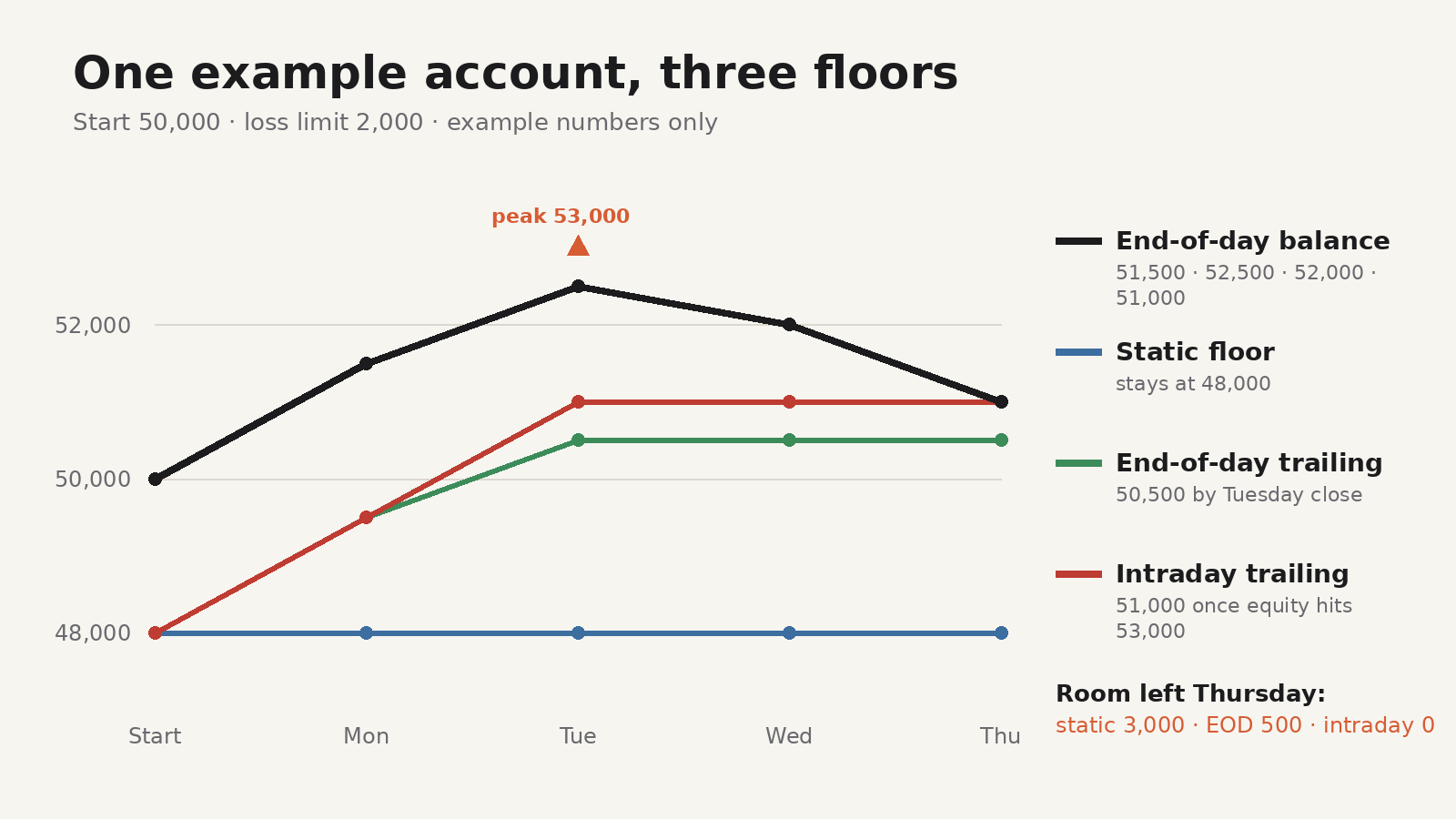
Here is one made-up week for the example account. End-of-day balances: Monday 51,500, Tuesday 52,500 (with an intraday peak of 53,000), Wednesday 52,000, Thursday 51,000.
| Static floor | EOD trailing floor | Intraday trailing floor | |
|---|---|---|---|
| Start | 48,000 | 48,000 | 48,000 |
| Mon close (51,500) | 48,000 | 49,500 | 49,500 |
| Tue close (52,500, peak 53,000) | 48,000 | 50,500 | 51,000 |
| Wed close (52,000) | 48,000 | 50,500 | 51,000 |
| Thu close (51,000) | 48,000 | 50,500 | 51,000 |
| Room left Thursday | 3,000 | 500 | 0 |
Same trades, same profit of 1,000 over the week, three different outcomes: 3,000 of room, 500 of room, or an account that hit its floor. (The intraday column assumes the floor sits 2,000 below the highest equity reached, as in Topstep's example. Real rules vary.)
Four questions to ask before you pay for an account
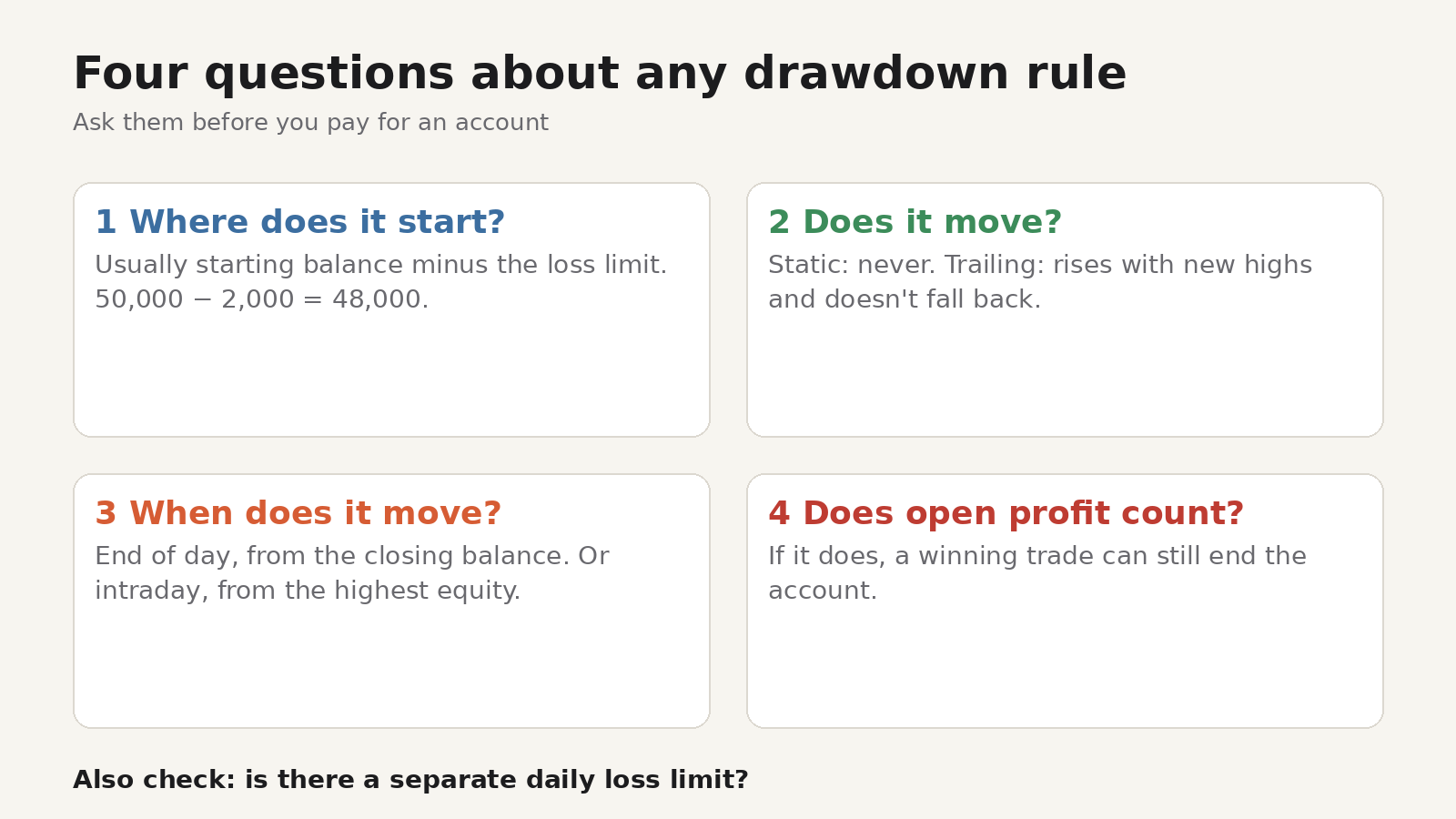
Topstep's explainer suggests four things to check when comparing firms. They apply to any rulebook:
- Where does the loss limit start?
- Does it move? Static or trailing.
- When does it move? At the end of the day, or intraday.
- Can unrealised profit move it? This is the one that surprises people.
Also check whether there's a separate daily loss limit. It's a different rule: the daily limit caps one day and the floor caps the account. Topstep's $100K static account, for example, lists a static $4,000 Maximum Loss Limit (a floor of $96,000 on a $100,000 start) with a mandatory $2,000 daily loss limit. Terms change, so check the current ones for any account you consider.
Turn the rule into numbers you can trade with
Once you know the floor, convert it into trades. Example numbers only:
- Room above the floor today: 3,000
- Risk per trade: 250 (this is 1R)
- Room in R: 12R
Now ask the questions that decide survival. How many full losses can you take before the floor? Does your daily limit stop you well before that? On a trailing account, does the floor move after a good day, so that tomorrow's room in R is smaller than today's? Write the room in R at the start of every session. If it has shrunk, size down.
Two habits help most:
- Plan how you'll manage a winner. On an intraday trailing account, a big open gain can tighten the floor behind you.
- Keep a daily limit tighter than the floor. A rule that stops you at 2R for the day protects you from the account-ending loss. Our guide to setting a daily loss limit covers how.
Doing the planning inside TradingView with TradeDesk
TradeDesk is a browser extension for Chrome and Firefox, made by UnifyBrowse, that adds a sidebar to TradingView. It doesn't read your prop firm's account rules or track a drawdown floor, so you enter your own numbers. What it does help with, on the Free plan, is the discipline around them:
- Risk calculator: size positions for stocks, forex, crypto, futures and CFDs, with the risk-to-reward ratio shown as you plan, so each trade risks the amount you intended.
- Pre-trade checklist: an editable list you go through before entering. You can add lines such as "Room above my floor in R: ___" and "Floor type checked: static, EOD or intraday".
- Discipline guardrails: a daily loss limit and a post-loss cooldown.
- Trading journal: log trades with before, during and after screenshots, tags, emotions and notes. The Free plan holds up to 100 trades.
- Basic statistics: trade count, win rate, P&L, profit factor, average R and an equity curve.
Your data is stored locally on your device. Pro removes the journal cap and adds advanced analytics and the ForexFactory economic calendar with alerts; see TradeDesk pricing.
TradeDesk is a planning and journaling tool, not financial advice. Trading involves risk of loss.
FAQ
What is the difference between static and trailing drawdown?
A static drawdown floor never moves from its starting level. A trailing drawdown floor rises as your account reaches new highs and doesn't fall back, so you can lose room by giving back profit.
What is intraday trailing drawdown?
It's a trailing floor that can update from your highest equity at any point in the session, including unrealised profit on open trades. You can be profitable on a trade and still reach the floor if the floor moved up behind your peak.
Is a daily loss limit the same as a drawdown limit?
No. A daily loss limit caps losses for one day. A drawdown limit is a floor under the whole account. Many accounts have both.
Does this post recommend a prop firm?
No. Topstep's materials are cited because they explain the difference clearly, and they describe Topstep's own rules. Read each firm's current terms before you buy.