Short answer: For about 14 hours from Friday evening, 20 November, Kraken's Canadian dollar markets traded far below every other market. Bitcoin changed hands at C$24,250 on Saturday morning, roughly 70% below the price on Kraken's own US dollar market at the same moment. Nothing was hacked: Kraken says every order was processed correctly and the trades stand. What happened is that large sell orders, sent "at market", ran into an order book with very few buyers. The lesson applies to any market you trade: a market order promises you a fill, not a price.
What happened on Kraken's CAD pairs
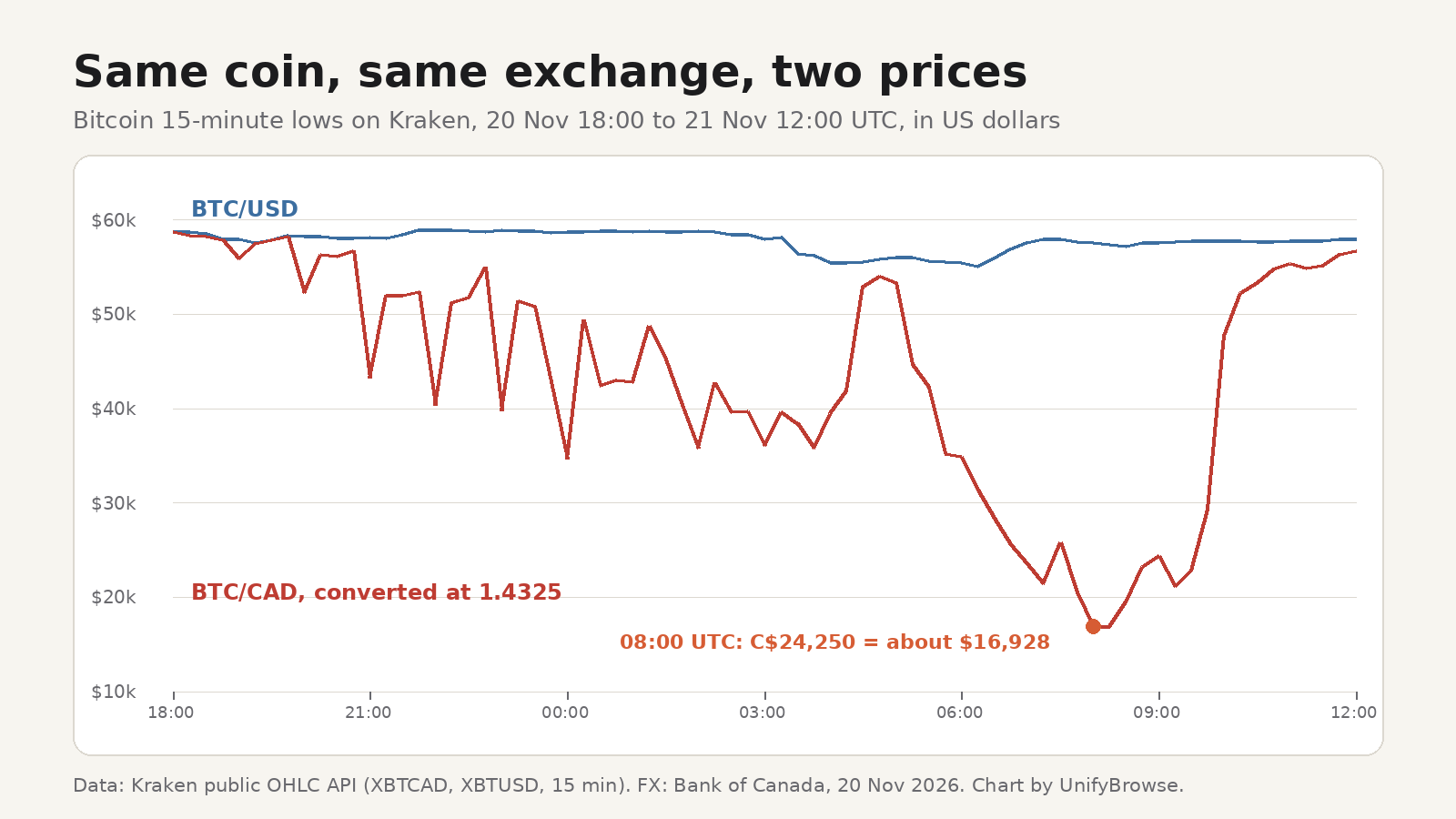
According to Kraken's public market data, the BTC/CAD pair was trading around C$84,000 on Friday evening, 20 November (UTC). In 15-minute steps it then printed lows of C$80,000, C$75,000 and C$61,880 over the next few hours, partly recovered overnight, and then fell again on Saturday morning: C$50,000 by 06:00 UTC, C$33,750 by 07:00 and C$24,250 at 08:00 UTC. By 10:00 UTC it was back near C$80,000.
At the Bank of Canada's rate for 20 November, 1.4325 Canadian dollars per US dollar, C$24,250 is about US$16,900. On Kraken's BTC/USD market in that same 15-minute window, bitcoin traded around US$57,600.
It wasn't only bitcoin. Kraken's US dollar to Canadian dollar pair, which normally sits around 1.43, briefly traded at 0.30 in the same window, and the USDC stablecoin traded below C$0.49. Every CAD market on the exchange was being pushed down at once.
Kraken Support posted on X on Saturday at 11:12 UTC: "Starting around 20:00 UTC on Nov 20, CAD pairs on Kraken saw heavy selling pressure that pushed prices well below other markets. Our platform processed every order correctly, and our security teams found no sign of a breach or compromised accounts. Executed trades stand."
Kraken hasn't said who was selling or why. An analysis of Kraken's public trade record by the crypto news site Coindaro found that the lowest prices lined up with market sell orders arriving on a fixed schedule, first hourly and later every 15 minutes, in a few repeated sizes. Whatever the reason, the size is the striking part. In the month before, BTC/CAD on Kraken traded between about 3 and 26 BTC a day, according to the exchange's daily candles. On 21 November (UTC) it traded more than 500 BTC.
This came during a rough week for crypto generally. Bitcoin had fallen to a two-year low near $55,000 on other markets, which we covered in our risk plan for buying the dip. But the CAD prices weren't a market-wide repricing. They were a local hole in one order book.
How an order book runs out of buyers
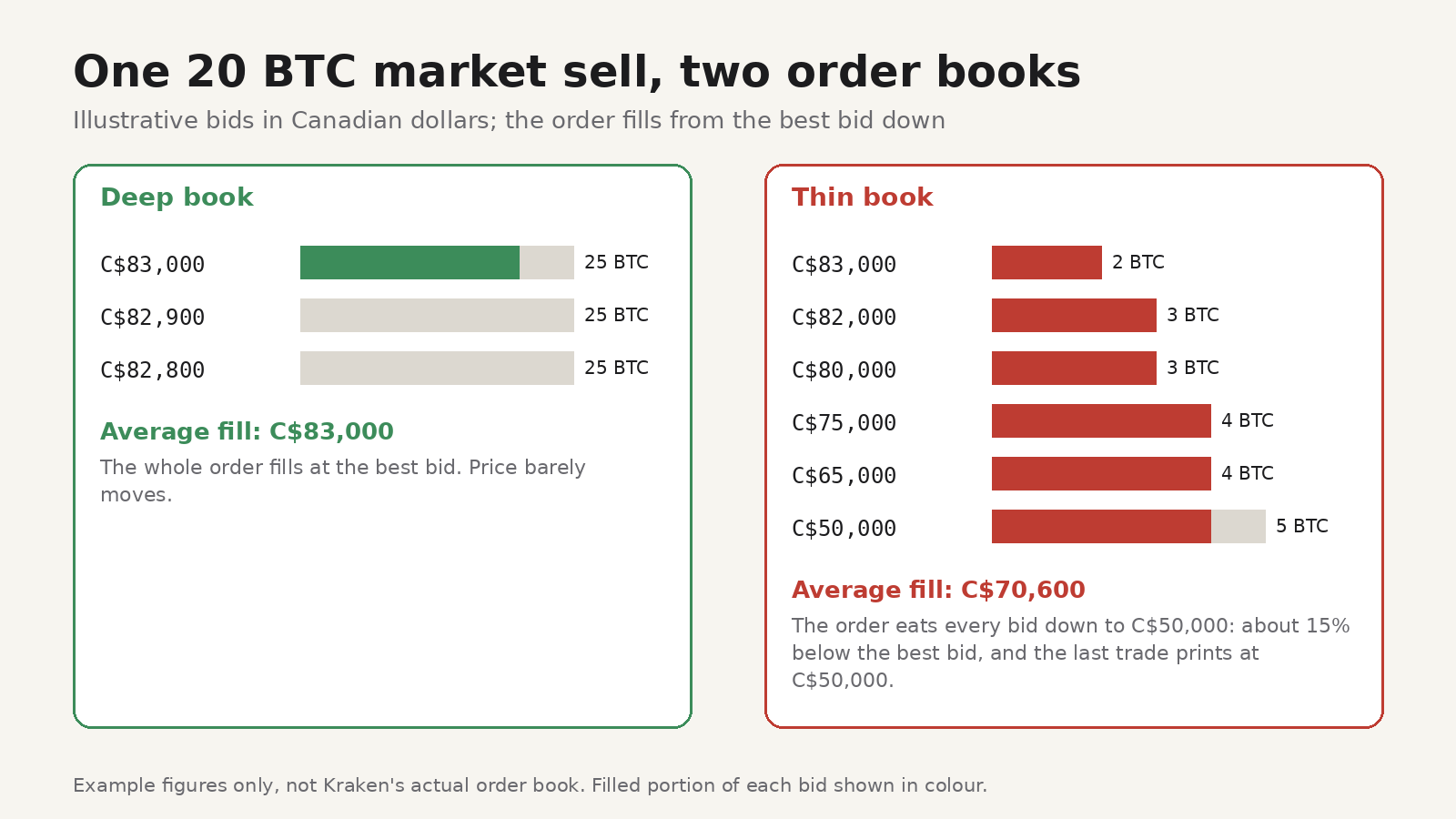
Every exchange market has an order book: a list of buyers (bids) waiting at different prices and sellers (asks) above them. When you send a market sell, you're telling the exchange to sell now, to whoever is bidding, at whatever price it takes to fill your whole size.
In a deep market, there are enough bids near the current price that a large order barely moves it. In a thin market, the best bid might be good for a fraction of a coin. Once it's used up, your order moves to the next bid, then the next, each lower than the last, until the full size is sold.
In normal times, arbitrage traders fill the gap quickly: if bitcoin is cheap on one market, they buy it there and sell it elsewhere. That's why prices usually line up across exchanges. But arbitrage needs money ready on both sides, and it can take time to move. On 20 and 21 November, the selling kept coming faster than the CAD side could refill, so each new order found an emptier book.
The people on the other side were the lucky ones. Anyone with a limit order to buy at a low CAD price got bitcoin far below its value elsewhere. The sellers got far less than they could have.
What this means for your own orders
You don't need to trade on Kraken, or in Canadian dollars, for this to matter. Thin books exist on smaller altcoins, on less common currency pairs, over weekends and holidays, and in the first and last minutes of a trading session. A few habits reduce the risk.
Prefer limit orders when size matters
A limit order sets the worst price you'll accept. A limit sell at C$82,000 can't fill at C$24,250. The trade-off is that it might not fill at all if the price moves away. For most traders, a missed trade is a better outcome than a fill at a third of the price.
Know what your stop actually does
A stop-market order becomes a market order when the stop price is touched. In a thin or fast market, it can fill far below your stop. A stop-limit order sets a floor on the fill price, but may not fill if the price jumps through it. Neither is perfect. Know which one you're using, and on thin markets expect slippage beyond your stop.
Check the book before you click
Before placing a large order, look at:
- the spread between the best bid and the best ask (a wide spread is the first warning),
- the size available at the best few prices compared with your order,
- the 24-hour volume on that exact pair, not the coin overall. Bitcoin is one of the most traded assets in the world, yet Kraken's BTC/CAD pair normally traded fewer than 30 coins a day.
If your order is a meaningful share of a day's volume, break it up, use limits, or trade on a deeper pair.
Build slippage into your risk
When you size a position, your planned loss assumes your stop fills at your stop. On a thin market, add a buffer for the gap between your stop and a realistic fill, and size down accordingly. If you're trading with leverage, a slippage spike can carry you past your stop and towards your liquidation price.
Have a rule for strange prices
If a price looks wildly off from other markets, stop and check before acting. Selling into a broken book is how losses get locked in. A personal daily loss limit helps here too, because it forces a pause after a bad fill instead of a rush to win it back.
Doing this in TradeDesk
TradeDesk is our extension for Chrome and Firefox that adds a collapsible sidebar to TradingView. It won't place or route orders for you, but it helps with the planning around them. According to its product page, the free plan includes:
- Risk calculator for stocks, forex, crypto, futures and CFDs, with the risk-to-reward ratio shown live, so you can size a position with a wider stop that accounts for slippage.
- Editable pre-trade checklist. Useful checklist lines: "Limit order, not market, on this pair" and "Order size checked against the pair's 24h volume and spread".
- Market sessions and world clocks, so you can see when you're trading outside a market's busiest hours.
- Discipline guardrails: a daily loss limit and a post-loss cooldown.
- Trading journal with screenshots, tags, emotions and notes, where you can record planned price against actual fill and spot slippage patterns over time.
Your data is stored locally on your device. Pro adds advanced analytics and other extras; see TradeDesk pricing.
TradeDesk is a planning and journaling tool, not financial advice. Trading involves risk of loss.
FAQ
Was Kraken hacked?
Kraken says no. Its support team said its security teams found no sign of a breach or compromised accounts and that every order was processed correctly.
Will Kraken reverse the trades?
Kraken says executed trades stand. It hasn't announced any compensation.
Why didn't arbitrage fix the price straight away?
Arbitrage needs capital ready in both currencies and time to move it. When the selling continued faster than buyers could refill the Canadian dollar side, prices stayed far apart for hours, then snapped back once the selling stopped.
Are market orders always a bad idea?
No. For small orders in deep, liquid markets, a market order usually fills close to the quoted price, and speed can matter. The risk grows with your order's size relative to the book, and with how thin and fast the market is.
Does this happen in stocks and forex?
Yes. Flash crashes have hit stocks, ETFs and currency pairs, usually when liquidity disappears for a short time. The same habits apply: limit orders, knowing how your stops work, and sizing for slippage.