Short answer: Your liquidation price is the price at which the exchange closes your leveraged position because the margin left in it no longer covers the minimum it requires. The higher the leverage, the closer that price sits to your entry. At 10x it's roughly 10% away, at 50x it's under 2%. Size the trade from your stop-loss, and make sure the stop sits well before the liquidation price, so your stop, not the exchange, decides when you're out.
Over the weekend of November 14–15, 2026, Bitcoin fell to around $62,000, its lowest level since July and about 14% down on the week, according to The Block. CoinGlass data cited in the same report showed $2.02 billion in crypto liquidations in 24 hours, $1.68 billion of it from long positions. Those traders didn't choose to exit. Their positions were closed for them.
This guide explains where that line comes from and how to check yours before you enter.
What liquidation actually is
When you open a leveraged position, you put up a slice of its value as margin. At 10x leverage, a $4,000 position needs $400 of margin. Price moves change the value of the whole $4,000 position, but the losses come out of your $400.
Exchanges also require a minimum amount of margin to keep the position open, called the maintenance margin. It's usually a small percentage of the position's value. When losses eat your margin down to that minimum, the exchange's liquidation engine closes the position. You lose the margin, and on many exchanges a liquidation fee comes on top.
Two details matter in practice:
- Most exchanges use a mark price, not the last traded price, to decide liquidation. The mark price is built from an index of several markets, so a single wick on one exchange doesn't always trigger it.
- The exact formula differs by exchange. Maintenance rates change with position size, fees and funding payments move the line, and cross margin works differently from isolated margin. Treat the numbers below as a way to understand the shape of the problem, and use your exchange's own liquidation price for real orders.
The simplified formula
For an isolated-margin position on a linear (USDT-settled) perpetual, ignoring fees and funding:
- Long: liquidation price = entry × (1 − 1 / leverage) ÷ (1 − maintenance rate)
- Short: liquidation price = entry × (1 + 1 / leverage) ÷ (1 + maintenance rate)
The 1 / leverage part is the key. It's the share of the position you paid for with your own money, so it's roughly how far price can move against you before that money is gone. The maintenance rate pulls the liquidation price a little closer to your entry than that.
A worked example at five leverage levels
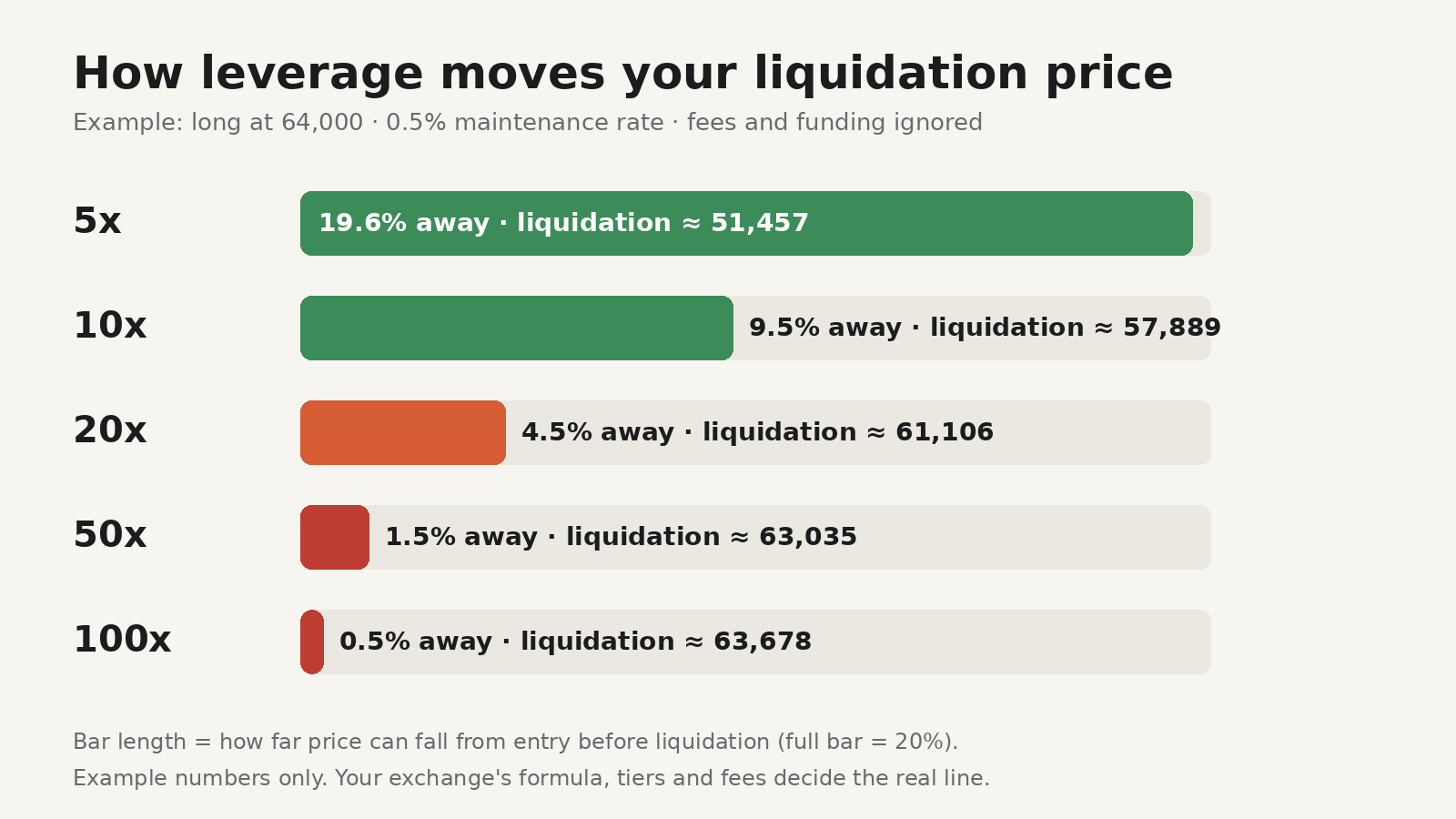
Take a long position in Bitcoin at $64,000 with a 0.5% maintenance rate. These are example numbers, not any exchange's actual parameters.
| Leverage | Liquidation price (long) | Distance from entry |
|---|---|---|
| 5x | $51,457 | 19.6% |
| 10x | $57,889 | 9.5% |
| 20x | $61,106 | 4.5% |
| 50x | $63,035 | 1.5% |
| 100x | $63,678 | 0.5% |
For a short at the same entry, the distances are almost the same, just above the entry: about $70,050 at 10x and $64,955 at 50x.
Now compare that with the weekend's move. A 14% weekly drop is wider than the distance to liquidation at 10x. A normal hourly swing in Bitcoin can be wider than 0.5%. At high leverage, ordinary noise is enough.
Leverage doesn't decide your risk. Your position size does.
This is the part that surprises people. Say you have a $10,000 account and you want to risk 1% ($100) on a long at $64,000, with a stop at $62,400, which is 2.5% below entry.
Position size = risk ÷ stop distance = $100 ÷ $1,600 = 0.0625 BTC, a $4,000 position.
That number doesn't depend on leverage at all. Leverage only changes how much margin the exchange locks up for it:
- At 5x, margin is $800 and the example liquidation price is $51,457.
- At 10x, margin is $400 and liquidation is $57,889.
- At 20x, margin is $200 and liquidation is $61,106.
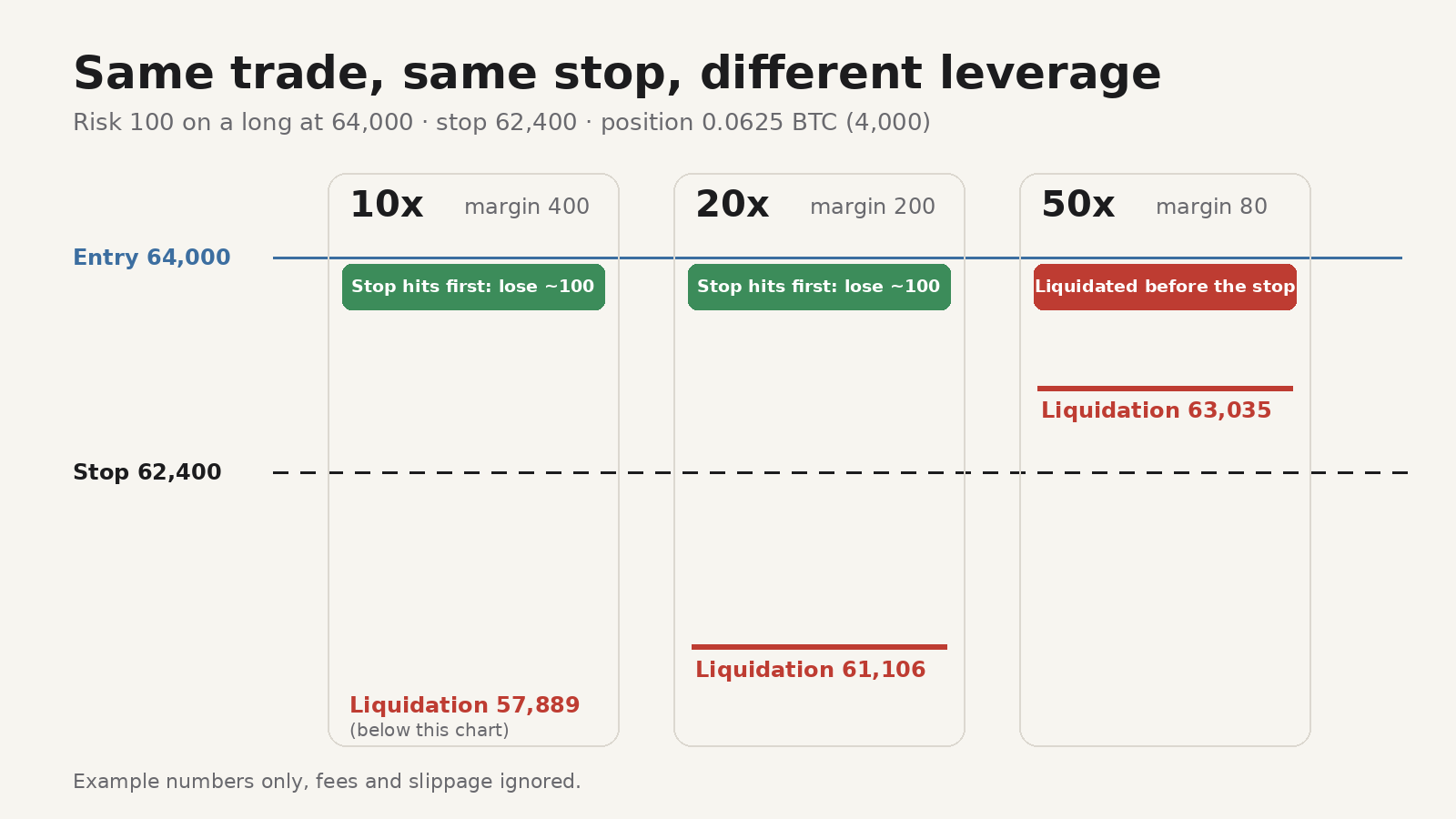
In all three cases, if the stop at $62,400 is hit, you lose about $100 plus fees. Your stop does the work, and liquidation is far enough away that it doesn't come into play.
At 50x, the margin would be $80, and the example liquidation price of $63,035 sits above your stop. The position would be closed before price ever reached $62,400, and you'd lose the full margin on a move you had planned to survive. That's the real danger of high leverage: not that it makes a trade risky by itself, but that it can put the liquidation line inside your plan.
The traders who get hurt most in a move like the weekend's are often the ones who sized the other way round: they picked leverage first, used most of their balance as margin, and had no stop at all.
A pre-trade check for leveraged positions
Before you enter, run through these:
- Write the stop first. Decide where the trade idea is wrong, and set the stop there.
- Size from the stop. Divide the amount you're willing to lose by the stop distance.
- Read the liquidation price from the order form. Most exchanges show an estimate before you confirm. If it isn't comfortably beyond your stop, lower the leverage.
- Leave a buffer. Fees, funding and slippage all move the real line. A stop just a few dollars before liquidation isn't a plan.
- Know your margin mode. In cross margin, one losing position can draw on the rest of your balance. Isolated margin limits each position to its own margin.
- Check the calendar. Big data releases move price fast. Our guide to trading around CPI and other high-impact news covers what to do on those days.
- Cap the day. A daily loss limit stops one bad move from turning into five revenge trades.
Doing the sizing inside TradingView with TradeDesk
TradeDesk is a browser extension for Chrome and Firefox, made by UnifyBrowse, that adds a sidebar to TradingView. It doesn't connect to your exchange or show your liquidation price, so you still read that from the exchange's order form. What it helps with, on the Free plan, is the part before the order:
- Risk calculator: size positions for stocks, forex, crypto, futures and CFDs from your risk and stop, with the risk-to-reward ratio shown as you plan.
- Pre-trade checklist: an editable list you go through before entering. You can add lines such as "Liquidation price beyond my stop: yes / no" and "Margin mode: isolated".
- Discipline guardrails: a daily loss limit and a post-loss cooldown.
- Trading journal: log trades with before, during and after screenshots, tags, emotions and notes. The Free plan holds up to 100 trades.
Your data is stored locally on your device. Pro removes the journal cap and adds advanced analytics and the ForexFactory economic calendar with alerts; see TradeDesk pricing.
TradeDesk is a planning and journaling tool, not financial advice. Trading involves risk of loss.
FAQ
Does lower leverage mean lower risk?
Not by itself. If you keep the same position size and the same stop, your loss at the stop is the same at any leverage. Lower leverage moves the liquidation price further away and locks up more margin. Higher leverage adds risk when it puts the liquidation price inside your stop, or when traders use the freed-up margin to hold a bigger position than they meant to.
Why was I liquidated before price reached my liquidation price?
Usually because the exchange uses a mark price, your maintenance rate stepped up with position size, or fees and funding reduced your margin. Check your exchange's trade history for the mark price at the time.
Is a stop-loss guaranteed to fill before liquidation?
No. In a fast market a stop can fill at a worse price than you set. That's another reason to keep a wide gap between your stop and the liquidation price.