Short answer: The quantum worry in the Bitcoin news is mostly about signatures, not hashes. A large enough quantum computer could, in theory, work out a private key from a public key that's already visible. Hash functions such as SHA-256 are affected much less: the best known quantum attack roughly halves their security level in bits, which still leaves a very large number. This isn't a forecast. As far as published reports go, no quantum computer today can do either.
On November 10, 2026, the analytics firm Glassnode said that 7.12 million BTC, or 35.4% of issued supply, sits in outputs whose public key is already visible on the blockchain, as reported by crypto.news. Glassnode says address reuse accounts for 25.8% of supply, and that the exchange-held part of the total falls within the reuse category rather than adding to it. Other blockchain projects have also been discussing post-quantum signatures. The headlines sound alarming, so this guide separates three ideas that get mixed up: hashing, signatures and encryption.
Hashes, signatures and encryption are different tools
- A hash function turns any input into a fixed-length fingerprint. SHA-256 always produces 256 bits, shown as 64 hexadecimal characters. You can't run it backwards to get the input.
- A digital signature proves you hold a private key without revealing it. Bitcoin uses elliptic-curve signatures: a private key signs a transaction, and anyone can check the signature against your public key.
- Encryption scrambles data so only someone with the key can read it. It isn't what protects Bitcoin transactions.
Hashing is one-way and has no key. A signature scheme has a key pair. They fail in different ways.
What a quantum computer could and couldn't do
Two quantum algorithms matter here.
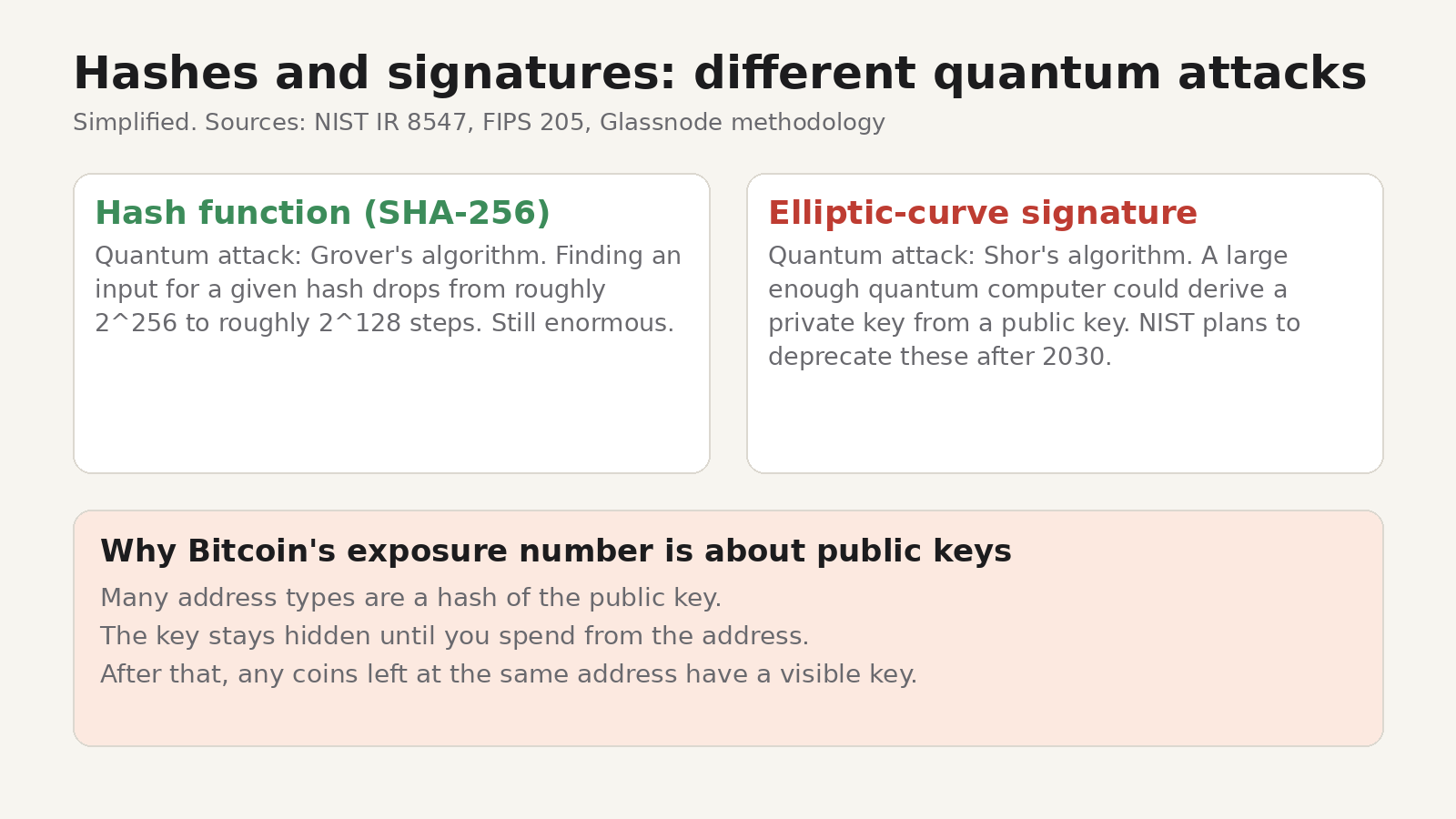
Shor's algorithm could, on a large enough quantum computer, break the maths behind elliptic-curve and RSA signatures: it could derive a private key from a public key. NIST's transition guidance (NIST IR 8547) lists ECDSA, RSA and EdDSA as vulnerable to it, and says NIST will deprecate those signature algorithms after 2030 and disallow them after 2035. NIST has also published post-quantum signature standards, ML-DSA (FIPS 204) and SLH-DSA (FIPS 205).
Grover's algorithm speeds up brute-force search. For an n-bit hash, finding an input that produces a given output takes on the order of 2^n guesses classically and on the order of 2^(n/2) quantum steps. For SHA-256 that means roughly 2^128 steps, which is still an astronomically large number. So hash functions are generally treated as holding up much better than signatures. In fact, SLH-DSA, one of NIST's post-quantum signature standards, is built from hash functions.
Quantum attacks also have heavy practical costs that this simple arithmetic ignores. The takeaway is the direction: signatures are the part that needs replacing, and hashes are the part other defences build on.
Why Bitcoin's "exposed" number is about public keys
A Bitcoin address, for many common output types, is a hash of your public key rather than the key itself. Glassnode's methodology notes that outputs of several types, including P2PKH, P2SH, P2WPKH and P2WSH, can hide public keys behind hashes while coins are at rest. The public key becomes visible when you spend from the address.
That creates the exposure Glassnode measures:
- Address reuse. If you spend from an address and leave some coins there, or receive new coins at an address you've already spent from, that address's public key is already public.
- Some output types reveal the key by design. Early pay-to-public-key outputs and Taproot outputs expose it, according to Glassnode's methodology.
Glassnode frames the measure as a snapshot of where public keys are visible, not as a prediction. Its wording is that moving coins from reused addresses to fresh ones ends that particular exposure. It isn't advice for any individual. If you hold crypto, follow your wallet's own documentation, and don't move funds on the strength of a blog post.
See hashing for yourself
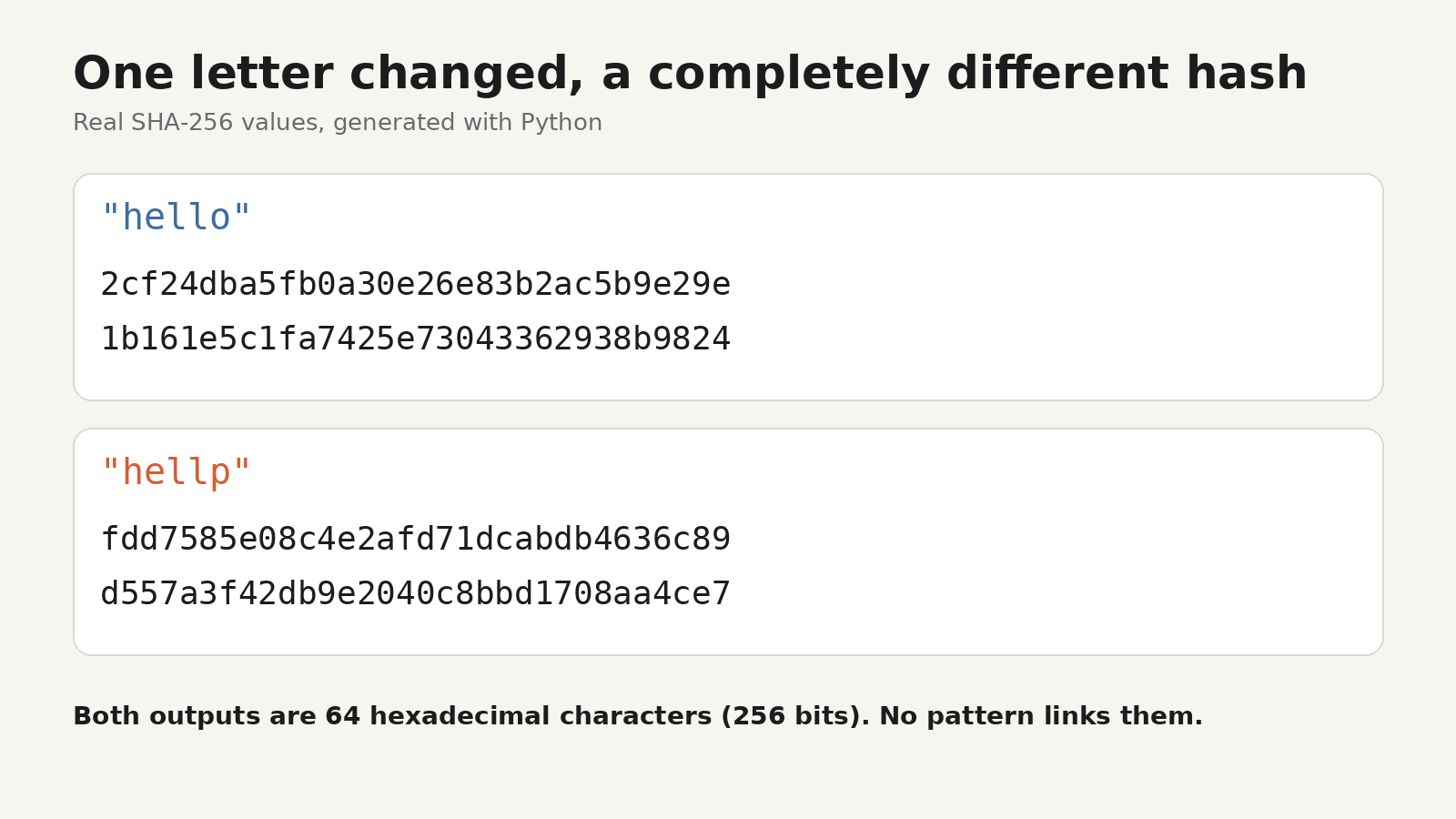
The fixed length and one-way behaviour are easy to see. These are real SHA-256 values we generated on our own machine with Python:
| Input | SHA-256 |
|---|---|
hello |
2cf24dba5fb0a30e26e83b2ac5b9e29e1b161e5c1fa7425e73043362938b9824 |
hellp |
fdd7585e08c4e2afd71dcabdb4636c89d557a3f42db9e2040c8bbd1708aa4ce7 |
Changing one letter changes the whole output. The two hashes share no visible pattern, and there's no way to look at the second and guess the first. A 1,000-character input still gives 64 hexadecimal characters. That's why hashes work as fingerprints for files, passwords stored on servers and, in Bitcoin's case, public keys.
What this means for you
- If you use crypto: the useful question isn't "will quantum break everything?" It's "does my wallet reuse addresses, and what does the wallet maker plan for post-quantum signatures?" Read the wallet's documentation and the project's roadmap.
- If you build software: hashes such as SHA-256 remain standard. Plan for signature and key-exchange algorithms to change over the next decade, following NIST's published timelines.
- If you just want to understand it: hash, sign and encrypt are different jobs. Most quantum headlines are about the signing and key-exchange part.
Checking hashes with HashLens
HashLens, a Chrome extension made by UnifyBrowse, lets you try this without writing code. It can generate hashes from text across 9 algorithms at once, so you can reproduce the table above. It can also identify an unknown hash: paste it and it suggests the likely algorithm (MD5, SHA-256, bcrypt, NTLM, Argon2 and 20+ more), shows the matching Hashcat mode and John the Ripper format, and gives each algorithm a Secure, Weak or Broken rating with a plain-English reason. A File Hash Verifier compares a downloaded file's checksum with the published one. It runs locally in your browser and is free. Some formats fit more than one algorithm, so treat an identification as a list of likely candidates; our guide on how to identify a hash type explains the patterns, and generating a SHA-256 hash walks through the basics.
FAQ
Can a quantum computer break SHA-256?
Not in any way that's known to be practical. The best known quantum attack on finding an input for a given SHA-256 hash takes about 2^128 steps, down from about 2^256 classically. That's still very large.
Is Bitcoin about to be hacked by quantum computers?
No quantum computer capable of that exists today, according to the reports cited here, and nobody can say when or whether one will. Glassnode's number measures which coins would be exposed if such a machine existed. It isn't a countdown.
What is the difference between hashing and encryption?
Hashing is one-way and has no key; you can't recover the input. Encryption is two-way: with the right key you can recover the data.
Is this investment or security advice?
No. It explains concepts using published sources. For decisions about your own funds, use your wallet's documentation and a qualified professional.