Short answer: US stock markets are open normally Monday to Wednesday this week, closed on Thursday 26 November for Thanksgiving, and close early at 1:00 p.m. ET on Friday 27 November. The bond market follows a similar pattern, with a recommended 2:00 p.m. ET close on Friday. Wednesday packs in the week's main US data at 8:30 a.m. ET: the second estimate of third-quarter GDP and October's personal income and spending report, which includes the PCE inflation measure. Coming straight after the market's worst week in more than 18 months, that makes for a short week with a crowded middle and a thin end. Below: the exact hours, the times in your time zone, and a simple plan.

Why this week needs a plan
Last Friday, 20 November, a sell-off in AI-linked stocks pulled the S&P 500 down 3.7% in a single day, its worst weekly loss in more than 18 months, and the Nasdaq composite turned negative for the year, according to the Associated Press. Bitcoin, which we covered in our risk plan for buying the dip, had already hit a two-year low.
Now add a holiday week. Many market participants take time off around Thanksgiving, so fewer orders may sit in the book, while the important data all lands on one morning. Nobody can tell you which way prices go from here. What you can control is when you're exposed, how big your positions are, and what you'll do if the market moves fast against you.
The exact hours
All times US Eastern. In late November that's EST, five hours behind UTC, since US clocks went back on 1 November.
Monday 23 to Wednesday 25 November: normal sessions. Stocks trade 9:30 a.m. to 4:00 p.m. ET. The NYSE doesn't list an early close for the Wednesday before Thanksgiving.
Wednesday 25 November, 8:30 a.m. ET: the data. The US Bureau of Economic Analysis release schedule lists two reports at the same minute:
- GDP (Second Estimate) and Corporate Profits, 3rd Quarter 2026: a revision of the first growth estimate for July to September.
- Personal Income and Outlays, October 2026: consumer spending, income and the PCE price index, the inflation measure the Federal Reserve uses for its 2% target.
Thursday 26 November: closed. The NYSE holiday calendar lists Thanksgiving Day as a full market holiday, and SIFMA, the industry body whose calendar the bond market follows, recommends a full close for US fixed income too.
Friday 27 November: early close. The NYSE says each of its markets "will close early at 1:00 p.m. (1:15 p.m. for eligible options)" that day, and its late trading sessions end at 5:00 p.m. instead of 8:00 p.m. SIFMA recommends that bond trading close at 2:00 p.m. ET. FINRA's trade reporting facilities run their regular session to 1:00 p.m. and post-market reporting to 5:00 p.m. Your broker may set its own cut-offs, so check its holiday notice.
The key times in your time zone
| Event | US Eastern | UTC / London | Berlin / Paris | Tokyo |
|---|---|---|---|---|
| Wednesday data (GDP, PCE) | Wed 8:30 a.m. | Wed 13:30 | Wed 14:30 | Wed 22:30 |
| Normal stock close | 4:00 p.m. | 21:00 | 22:00 | 06:00 next day |
| Friday stock close | Fri 1:00 p.m. | Fri 18:00 | Fri 19:00 | Sat 03:00 |
| Friday bond close (SIFMA) | Fri 2:00 p.m. | Fri 19:00 | Fri 20:00 | Sat 04:00 |
| Friday late sessions end | Fri 5:00 p.m. | Fri 22:00 | Fri 23:00 | Sat 07:00 |
Futures exchanges publish their own holiday schedules, which don't always match the stock market's, so check your exchange before you plan around a futures position. Crypto markets don't close at all, which means they keep trading on Thursday while US stock markets are shut.
Why thin markets move differently
When fewer participants are active, there are fewer resting orders at each price. A large order, or a burst of orders after a data surprise, can move the price further than it would on a busy day, and the gap between the best bid and the best offer can widen. We walked through an extreme example in our piece on the Kraken CAD flash crash, where a thin order book let bitcoin trade far below every other market for hours.
Thin doesn't always mean volatile. Plenty of holiday sessions are simply quiet. The point is that the usual relationship between your order size and the price you get is less reliable, so market orders and tight stops deserve more care than usual.
A five-step plan for the week
1. Decide now what you'll do at 8:30 a.m. on Wednesday
Pick one of three positions before the data, not during it: be flat, hold a reduced position you're comfortable carrying through a big move, or hold your normal position with a wider stop and a smaller size. Our guide to trading around high-impact news covers the trade-offs in more detail.
2. Size for the stop you actually need
If the market is moving more, a stop at your usual distance may get hit by noise. The fix is to widen the stop and shrink the position so the money at risk stays the same.
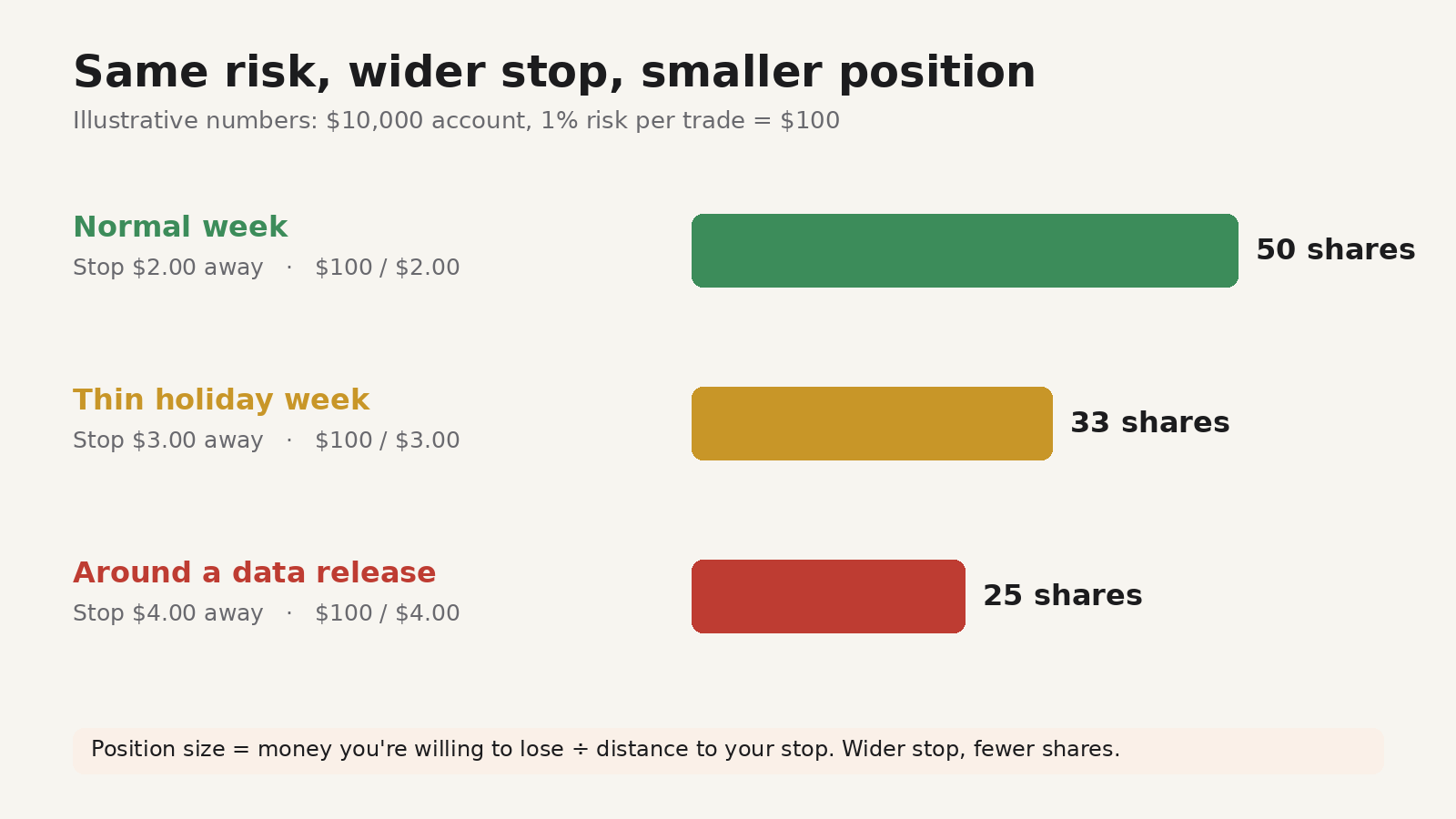
The numbers above are illustrative. The rule is simple: position size = money you're willing to lose ÷ distance to your stop. Widen the stop, and the share count drops.
3. Clean up open orders before Thursday
Good-till-cancelled orders and alerts don't take a holiday off. Before Wednesday's close, go through every resting order and ask whether you'd still place it today. A stale limit order sitting in a thin Friday session is easy to forget.
4. Remember Friday ends at 1:00 p.m. ET
If you usually manage positions in the last hour of the day, that hour is now 12:00 to 1:00 p.m. ET, and the closing auction happens three hours earlier than normal. Put the time in your calendar in your own time zone.
5. Set a daily loss limit and stick to it
Choppy weeks invite revenge trades. Decide your maximum loss for the day before the open, and stop when you hit it. If you haven't set one before, our explainer on daily loss limits shows how to pick a number.
How TradeDesk helps this week
TradeDesk is a browser extension that sits inside TradingView as a sidebar. On the free plan you get:
- a risk calculator for stocks, forex, crypto, futures and CFDs, with live reward-to-risk, so you can resize positions quickly when you widen a stop;
- market sessions and world clocks, useful when the closing time you're used to has moved;
- an editable pre-trade checklist, where you can add a line like "holiday week: early close Friday, data Wednesday 8:30 ET";
- discipline guardrails: a daily loss limit and a post-loss cooldown;
- a trading journal for up to 100 trades, with screenshots, tags and notes. Tag this week's trades "holiday week" and review them later with our weekly journal review routine.
TradeDesk Pro adds the ForexFactory economic calendar with alerts, so releases like Wednesday's show up before they hit. Your journal is stored locally on your device, not on a server.
TradeDesk is a planning and journaling tool, not financial advice. Trading involves risk of loss.
FAQ
Is the stock market open on the Wednesday before Thanksgiving?
Yes. It's a normal full session, 9:30 a.m. to 4:00 p.m. ET. The NYSE doesn't list an early close that day.
Is the stock market open on Black Friday?
Yes, but only until 1:00 p.m. ET for regular trading (1:15 p.m. for eligible options). NYSE late trading sessions end at 5:00 p.m. ET.
Is the bond market open the day after Thanksgiving?
SIFMA recommends an early close at 2:00 p.m. ET on Friday 27 November, after a full close on Thursday.
What time is the PCE report this week?
Wednesday 25 November at 8:30 a.m. ET (13:30 UTC), released together with the second estimate of third-quarter GDP.
Does crypto close for Thanksgiving?
No. Crypto markets trade every day, including holidays.